Proprietary epigenetic intelligence for professional football organisations. From player analytics to player development. Every insight delivered through a private, club-dedicated channel.
Genetics is your hardware. Epigenetics is the software: the live cellular programming that responds to training load, nutrition, sleep, and stress. We measure DNA methylation and miRNA expression to build a biological profile no fitness tracker can replicate.

The primary epigenetic mark. CpG-site methylation across panels validated in athletic cohorts reveals biological age, cellular stress load, and tissue-specific adaptation.
Chronological age is fixed. Biological age is fluid. Longitudinal monitoring detects accelerated epigenetic aging before it shows up as performance decline or injury.
MicroRNAs regulate muscle regeneration, inflammation, and metabolic adaptation, reacting within days to load, sleep, nutrition, and stress. Our panels read these circulating signatures to flag overreaching, underrecovery, and soft-tissue risk.
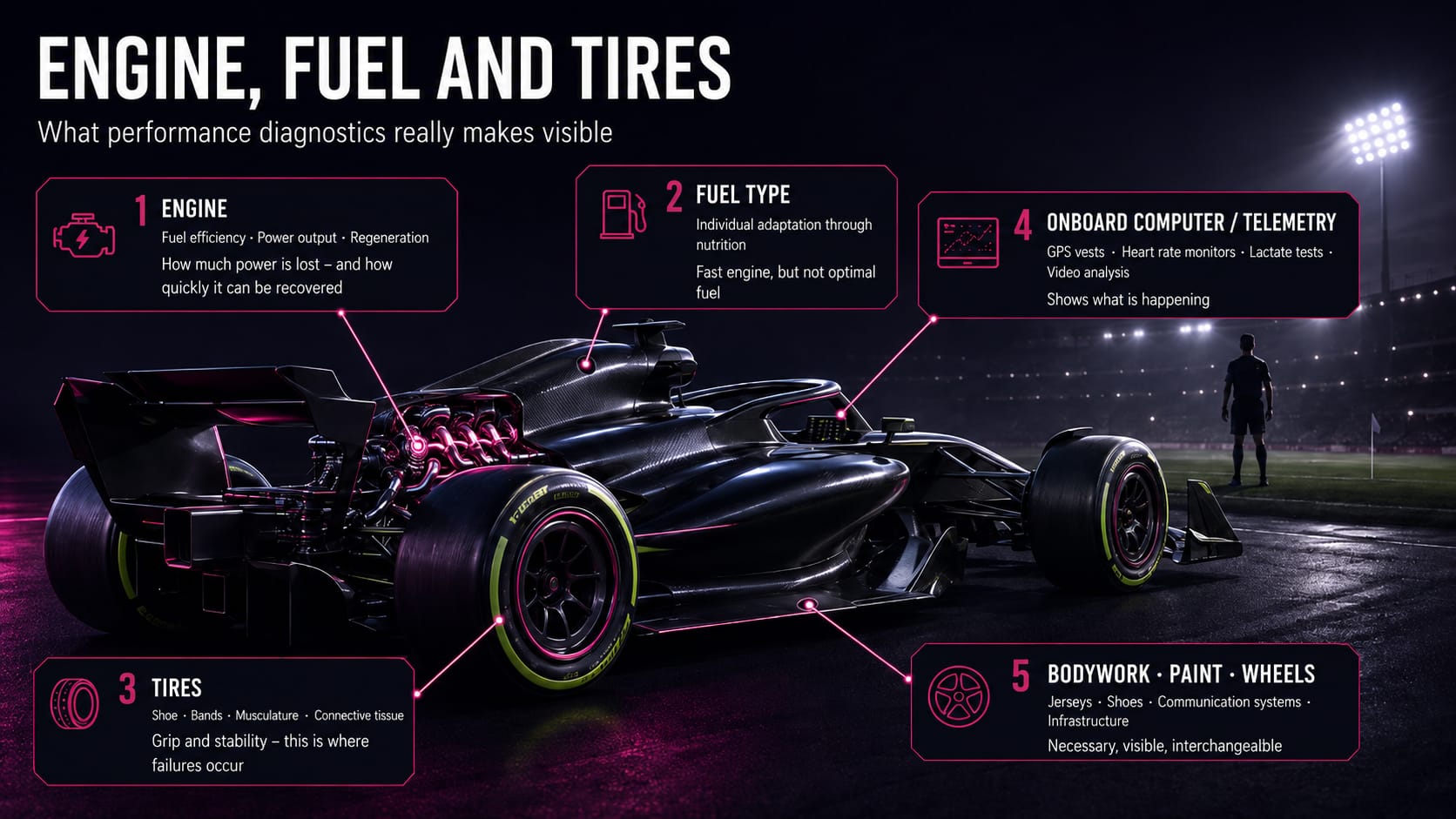
GPS vests, heart rate, and lactate tell you what happened on the pitch. Epigenetic and miRNA diagnostics open the bonnet, showing the engine, the fuel, and the tyres of each athlete at cell level, before the lap time drops or the hamstring goes.
Two layers no wearable can deliver: what is fixed in a player forever, and what is changing in them this week.
MicroRNAs are small regulatory molecules that switch genes on and off. They react within days to training load, sleep, nutrition and stress. Measured repeatedly, they show the current cellular state of the athlete.
ACE, ACTN3, FTO and BDNF are measured once and never change. They define sport type, muscle architecture, injury susceptibility, and how strongly a player responds to training at all.
A structured baseline of nutrition and lifestyle factors, scored against scientific reference values and reported as a diet score and a lifestyle score.
Every evaluation is an algorithm built from several microRNAs, reported on a 1–9 scale: 7–9 optimal, 4–6 average, 1–3 outside the optimal range. Together they form the Fitness & Health Score: one headline number per player, per measurement.
Vitamin and micronutrient demand (B vitamins, iron, magnesium, zinc). The right fuel improves output and supports recovery.
Fluid is lost through sweat and respiration. Even mild dehydration degrades physiological function and sprint performance.
Recovery is the single best injury prevention there is. This score shows how much load a player can absorb before risk rises.
Distinguishes healthy challenge from chronic overload: the imbalance behind fatigue and dropping performance.
How efficiently heart and circulation deliver oxygen. Correlates with VO₂max and endurance predisposition.
Training lowers inflammation; overtraining raises it. Silent inflammatory load is the early warning before breakdown.
Quality of skeletal muscle tissue: vitality, build-up capacity and current muscular condition.
Read alone it is a signal; read in combination it becomes a decision.
Genotypes place a player on the scale from pure endurance type to pure power type, and explain why two players on the same programme respond completely differently.
Influences the bradykinin-aldosterone system. Variants are associated with explosive strength or with endurance capacity.
The 'speed gene'. Determines the balance of fast- and slow-twitch fibres, and the risk of muscle damage under sprint load.
How strongly body composition responds to physical activity: how much leverage training has on this player's metabolism.
The neurochemical reward after exercise. Low responders need structure, routine and partners rather than more talk.
One small blood prick per player, taken at the club: no training time lost, no lab visit. WADA-compliant and repeatable across a season: measure, intervene, measure again, with re-testing every 8–12 weeks tracking each player's trend against their target scenario.
Most competitors are lab-only or clinic-only. Goal Health owns both ends of the value chain: proprietary biomarker discovery on one side, applied performance medicine on the other.
Bespoke epigenetic panels developed and validated exclusively for professional football organisations, under strict NDA, with full client data sovereignty. No shared databases. No pooled reporting.
Our clinical team translates epigenetic data into actionable protocols: nutrition, load management, recovery, and supplementation, all tailored to each player and the club's competitive calendar.
"The gap between what elite clubs believe about genetics and what they actually implement is the single largest untapped advantage in professional football."Goal Health Ltd, research thesis
Genetic testing reads your fixed DNA sequence: what you were born with. Epigenetic testing reads the chemical marks on top of it: how your body is responding to training, nutrition, and stress right now. Genetics is about potential; epigenetics is about condition. This is not gene doping or modification; it is reading the biological signals your body already produces after every match, every training block, every recovery session.
The stigma around "genetic testing" in sport has held back a technology that can prevent injuries and extend careers. Our mission is to change that, one club at a time.
This section is available as a private briefing for club medical departments and performance directors upon request.
Measurable player analytics and development outcomes, not wellness trends. The same data that protects the first team informs the academy pathway.
Epigenetic load signatures precede musculoskeletal failure by weeks, flagging elevated cellular stress before GPS or force-plate data shows decline, so load is adjusted proactively.
A 22-year-old may be 26 biologically, or 20. Longitudinal tracking informs contract decisions, periodisation, and career-extension protocols.
Sleep, nutrition, and travel shift methylation status measurably. Protocols are built on each player's epigenetic recovery phenotype, not generic best practice.
Identical sessions produce different cellular stress responses. Epigenetic monitoring reveals who adapts and who accumulates damage.
Grounded in published research and validated through controlled studies with professional athletic cohorts. No hype.
A landmark study from the Barça Innovation Hub and IDIBAPS identified over 1,000 differentially methylated regions associated with injury risk in professional players. Our laboratory extends this work through proprietary panels developed with UK-based cohorts.
Longitudinal monitoring shows players' biological age drops post-match during active recovery, but accelerates under chronic congested fixture schedules. This provides an objective biomarker for load management decisions.
The gap between belief and implementation represents the single largest opportunity in sports performance medicine. Early adopters gain measurable competitive advantage in injury prevention and player retention.
All testing is conducted within WADA guidelines. Player data remains the property of the player, not the club. We provide the analytical framework; clubs and players make the decisions. No selection discrimination. No genetic determinism.
Every partnership is bespoke, delivered through a private club-dedicated channel. No shared dashboards. No templated reports.
Pre-signing epigenetic screening for incoming transfers. One-time biological age assessment and injury-risk stratification delivered through your private client channel.
Seasonal monitoring for the first team, youth squads, and academy. Biological age tracking, load-response profiling, and quarterly clinical reviews, all through your dedicated, encrypted portal.
Proprietary research partnership. For clubs seeking to develop exclusive biomarker panels and publish original research, with full control over data and intellectual property.
We speak the language of both the laboratory and the dressing room.
Oversees the translation of molecular data into the nutrition, load and recovery protocols players actually follow, and the club strategy that delivers them.
Carries the weight of player development: pathways, progression and the standards that turn potential into careers, across every level of the game.
Owns the science end to end: panel design, validation, and research standards. PhD in molecular epigenetics, with published work on DNA methylation in elite athletes.
Deep expertise in healthcare management, working exactly where laboratory science meets clinical application.
Integrates regenerative wellness expertise with elite performance practice: recovery, longevity and player wellbeing built into every programme.
We work with a limited number of elite football organisations each season. All enquiries are handled personally and confidentially.
info@goalhealth.co.uk